
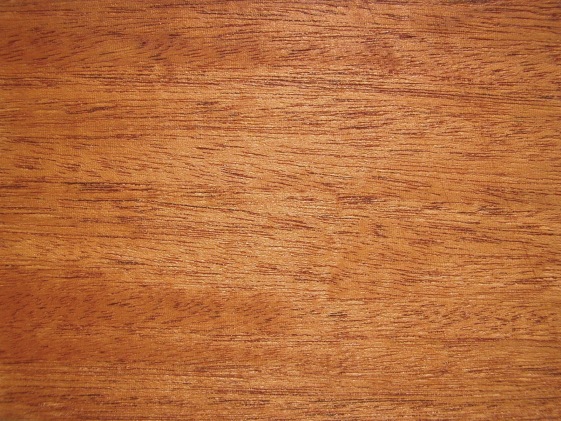
Common trade names: Mahogany, Genuine Mahogany, Honduran Mahogany, Brazilian Mahogany
Genus: Swietenia macrophylla
Janka Hardness (pounds-force): 900
Description: Medium texture and pores, generally speaking. Heartwood of Honduran Mahogany can vary quite a little bit from pale pinks to deep red browns. The color will deepen in time, usually. Honduran Mahogany is marketed by many as “Genuine” Mahogany to provide a distinction between this product and African variations on the mahogany product. Cuban Mahogany is a different species yet, but the Honduran mahogany was predominantly traded in the eighteenth century. African replaced the American mahoganies as the worldwide primary supply over the previous century. Today, Honduran Mahogany is widely plantationed, and is available worldwide, but usually at a cost. The history of the mahogany trade is that of the industry being mostly reactive and sluggish to respond to supply variations among species, but the industry has, by and large, learned many lessons in diversification and sourcing of various species. Honduran mahogany remains in high demand worldwide, though most of its production today is in the Asian tropics and Isles.
Location: The tropics. Native to: Mexico through Central America. Farmed in: Bahamas, Belize, Brazil, Columbia, Cuba, Hispaniola, Honduras, Indonesia, Jamaica, Mexico, Panama, Puerto Rico, Venezuala.
Common Aliases: Acajou, Acajou d’Amerique, American mahogany, Bay mahogany,Madeira, Caobilla, Cedro espinoso, Large leaf mahogany, Tabasco mahogany.
Performance: Glues and finishes very well. Machines well, but the grain can be easily torn by reckless machining. Sands exceptionally easily. Turns, stains, and finishes quite well. Can be vulnerable to insect attack, but Honduran Mahogany is primarily an interior finish wood.
Common Uses: Furniture, millwork, turntables, speakers, audio equipment, cabinetmaking, chairs, dinettes, veneers, flooring, moldings, paneling, hatracks, shipbuilding, canoes, coffins.
From: The Wood Database
Common Name(s): Honduran Mahogany, Honduras Mahogany, American Mahogany, Genuine Mahogany, Big-Leaf Mahogany, Brazilian Mahogany
Scientific Name: Swietenia macrophylla
Distribution: From Southern Mexico to central South America; also commonly grown on plantations
Tree Size: 150 ft (45 m) tall, 6 ft (2 m) trunk diameter
Average Dried Weight: 41 lbs/ft3 (655 kg/m3)
Basic Specific Gravity: .54
Hardness: 900 lbf (4,000 N)
Rupture Strength: 11,660 lbf/in2 (80,390 kPa)
Elastic Strength: 1,386,000 lbf/in2 (9,560 MPa)
Crushing Strength: 6,550 lbf/in2 (45.2 MPa)
Shrinkage: Radial: 3.0%, Tangential: 4.1%, Volumetric: 7.8%, T/R Ratio: 1.4